
DeerRun X20 Treadmill Review

Share This!
DeerRun X20 Treadmill Review – Is This Really a 400 lb. Capacity Treadmill?
$799
Made in China
If you spend any time shopping for treadmills online, there’s a pretty good chance you’ve seen DeerRun. They advertise heavily across the internet, and the DeerRun X20 caught our attention for one very specific reason: they advertise a 400 lb. maximum user weight capacity.
Normally, we wouldn’t spend the time and money to purchase and test an $800 treadmill. There are hundreds of inexpensive treadmills online, and that really isn’t what Big Guy Treadmill Review is about.
But once you put a 400 lb. user weight rating on a treadmill, you’re officially in our territory.
So, DeerRun – you’re not getting off that easily.
We purchased the X20 and evaluated it the same way we look at other treadmills marketed toward larger users. As always, this review reflects our own experience and opinions. Your experience may be different, so take it for what it’s worth.
DeerRun X20 – The Important Specs
Let’s start with the basics:
- MSRP: Approximately $800
- Advertised Maximum User Weight: 400 lbs.
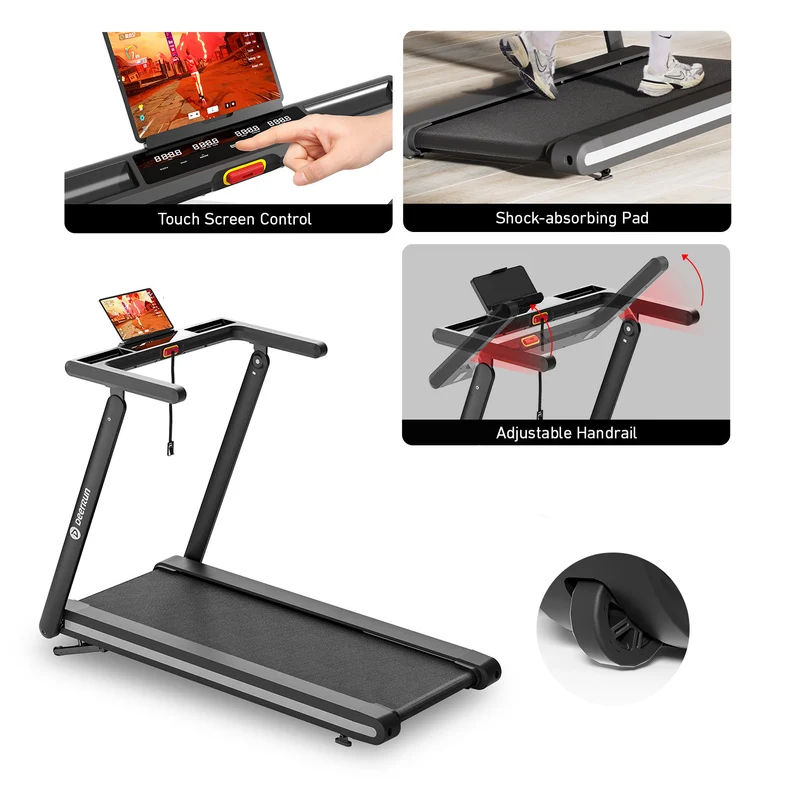
- Incline: Up to 15%
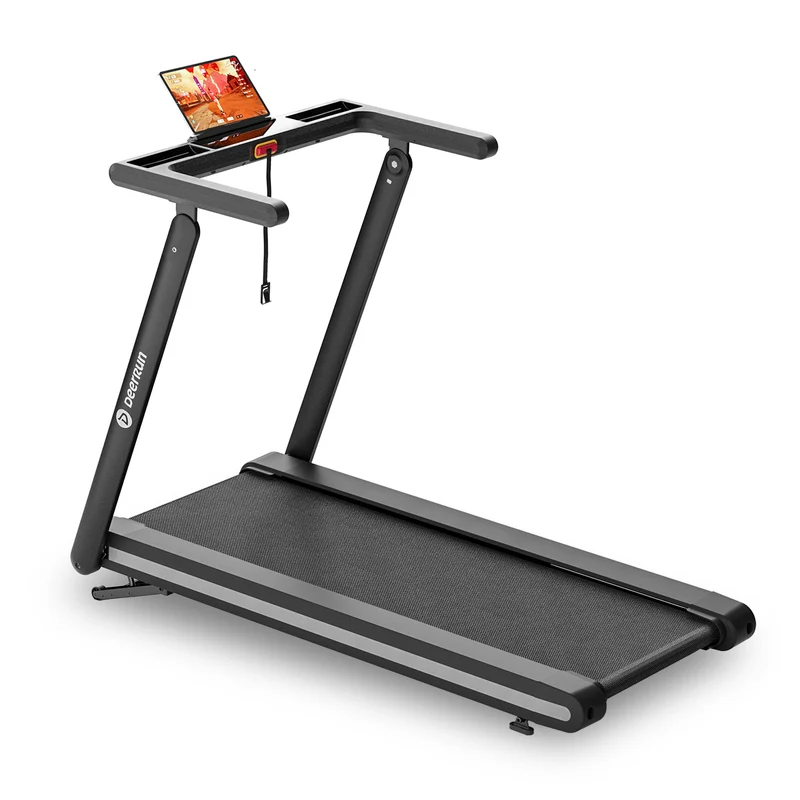
- Walking/Running Surface: Approximately 17.25″ wide x 52″ long
- Design: Fold-flat treadmill
- Warranty: 1-year product warranty
After going through our testing and scoring process, the Big Guy Treadmill Review overall score came in at just 67/100.
That is a very low score by our standards.
Unfortunately, there were several reasons for it.
Getting Started Was More Difficult Than It Should Be
Our problems with the X20 started almost immediately.
A treadmill should not be difficult to get up and running for the first time. Plug it in, turn it on, and let’s go.
That wasn’t our experience here.
One of our biggest annoyances was having to scan a QR code and download an app just to get started with the treadmill.
Why?
Maybe we’re old school, but if we buy a treadmill, we want to be able to get on the treadmill and use it. Requiring an app during initial setup feels like an unnecessary complication.
The Uprights Don’t Lock Into Place?
This was probably our biggest head-scratcher.
The X20 is designed so the uprights can fold down, which makes the treadmill easier to store. That’s fine.
But on the unit we tested, the uprights did not appear to positively lock into the upright position.
Push down on them and they can collapse.
Are we missing something?
We went back and looked because it seemed strange enough that we thought we must have overlooked a locking mechanism.
If there is a proper way to positively lock the uprights into position, it certainly wasn’t obvious to us during setup. If there isn’t, we consider that a legitimate safety concern.
Either way, this should be much more straightforward.
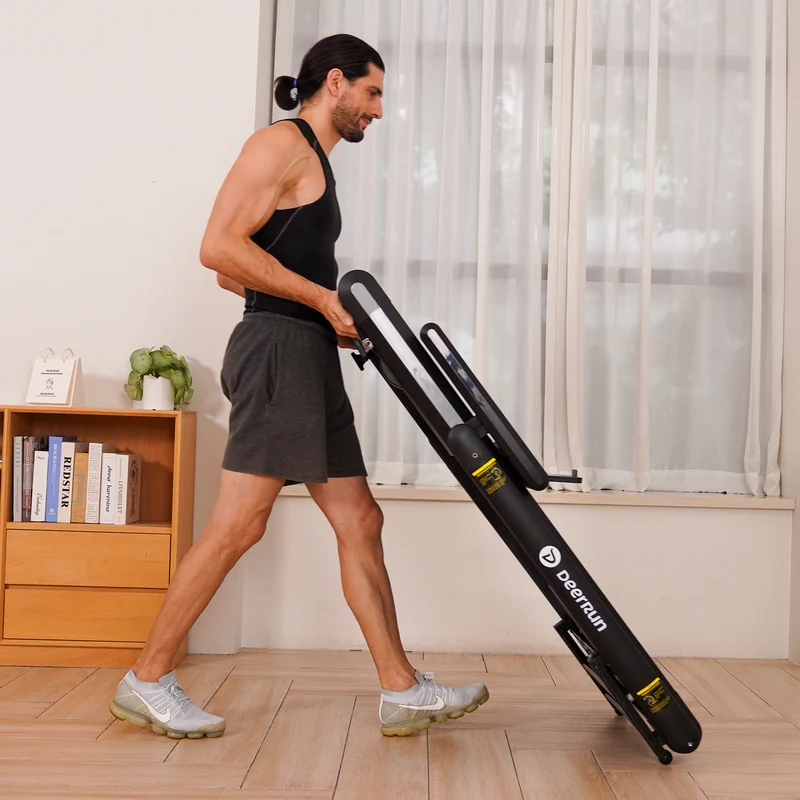
Fold Flat? Sort Of.
One of the X20’s selling points is its ability to fold flat for storage.
And technically, yes, it folds down.
But don’t picture an ultra-thin treadmill disappearing underneath every couch or bed. As you can see from our photos, it isn’t exactly super-flat when folded.
The folding design does make the treadmill more compact, but we weren’t particularly impressed with how the system was executed.
Belt Slipping Right Out of the Box
This was a much bigger concern.
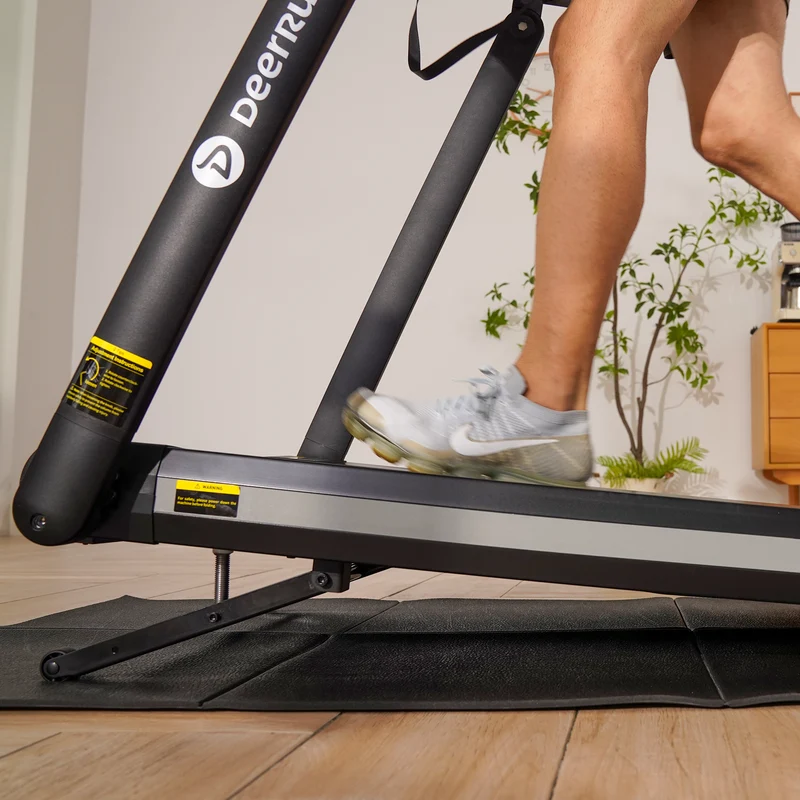
At approximately 3 MPH, our test treadmill was already experiencing some skipping/slipping right out of the box.
That normally indicates that something needs adjustment – possibly drive-belt tension, walking-belt tension, or roller adjustment.
Those are things that can usually be corrected.
But remember why we’re reviewing this treadmill in the first place:
400 lb. maximum user weight.
If we’re already experiencing slipping at a relatively low speed on a brand-new treadmill, that doesn’t exactly inspire confidence in its ability to handle a 400 lb. person walking – or especially running – at higher speeds and inclines.
Based on the construction and feel of the treadmill we tested, we would personally be very hesitant to recommend the X20 for someone anywhere near its advertised 400 lb. maximum capacity.
That Incline Motor Is LOUD
We’ll give the X20 credit for having power incline.
At this price point, a 15% incline is an attractive feature.
Unfortunately, the elevation motor on our test machine was surprisingly loud when raising and lowering the deck.
It’s not necessarily a deal-breaker by itself, but it contributes to the overall impression that this is a budget treadmill.
How Does It Feel?
This is where the X20 really lost us.
It just doesn’t feel substantial.
When we review treadmills for larger users, we’re looking for things like frame stability, deck feel, walking surface, overall construction and whether the machine feels comfortable and secure underneath you.
The X20 feels like an inexpensive treadmill.
And that’s okay – it is an inexpensive treadmill.
Our problem is the 400 lb. weight-capacity claim.
There’s a big difference between building a lightweight treadmill for someone who wants an inexpensive machine for casual walking and building a treadmill we’d feel comfortable recommending to a 350-400 lb. person.
Those aren’t the same thing.
In our opinion, the X20 feels much better suited to lighter-duty walking and occasional home use than serious use by someone approaching the advertised maximum capacity.
The Warranty Doesn’t Help
The warranty is another concern.
DeerRun lists a 1-year product warranty for the X20.
That’s short.
More importantly, we weren’t completely clear on what happens if the treadmill develops a significant problem. Is someone dispatched to your home? Are parts shipped to you? Do you perform the repair yourself? Does the treadmill have to be returned?
For a small treadmill, maybe that’s manageable.
But treadmills aren’t exactly something most people want to box back up and ship somewhere every time there’s a problem.
For a treadmill marketed toward users weighing as much as 400 lbs., we’d like to see a much stronger and more clearly defined warranty and service program.
What We Like
There are a few positives.
The X20 is relatively small and lightweight compared with traditional heavy-duty treadmills. It folds down to reduce its footprint, has power incline, and sells for less than $800.
And yes, you can walk on it, incline it, and run on it.
Kind of.
The problem is that none of those things were enough to overcome our concerns.
What We Don’t Like
Unfortunately, this list is considerably longer.
The folding uprights on our machine did not appear to positively lock into position. Setup required scanning a QR code and downloading an app. Our treadmill experienced belt slipping/skipping around 3 MPH right out of the box. The incline motor was loud. The running surface is relatively narrow at approximately 17.25 inches, and the overall construction simply didn’t give us confidence in the advertised 400 lb. user capacity.
Then there’s the one-year warranty, which is especially concerning on a treadmill being marketed toward heavier users.
Most importantly, we simply have a hard time believing this is a treadmill we’d want a 400 lb. person using regularly, particularly at higher speeds or steep inclines.
Could it physically support 400 lbs.? Maybe.
But there’s a big difference between supporting 400 lbs. and being a treadmill we’d actually recommend for a 400 lb. person.
That’s an important distinction.
Big Guy Treadmill Review Verdict
Overall Score: 67/100
The DeerRun X20 isn’t completely unusable. For someone looking for a compact, inexpensive treadmill primarily for lighter walking, there may be some appeal here.
But that’s not how we’re evaluating it.
DeerRun advertises the X20 with a 400 lb. maximum user weight, and that puts it into a completely different category.
For bigger users, we want stability. We want a wider and more comfortable walking surface. We want a treadmill that feels substantial underneath you. We want confidence in the drive system, frame and incline system. And we want a warranty that gives us some reassurance that the manufacturer expects the treadmill to last.
The X20 simply didn’t check enough of those boxes for us.
At roughly $800, we would personally look at other options before purchasing the X20, including entry-level models from established treadmill manufacturers such as Horizon Fitness.
The DeerRun X20 is small. It’s relatively inexpensive. It folds down… sort of. It inclines. And technically, you can run on it.
But if you’re a genuinely big guy looking for a treadmill specifically because you need something capable of safely and reliably handling a heavier user?
This one would not be high on our list.
Horizon Fitness 7.8 AT Treadmill
Made in China
This comparison is going to share a similar theme to the review we did on the Horizon 7.0 AT Treadmill. Good price point, heavy duty frame but lacking on the important stuff. We had another issue with the incline not being able to hold my weight and causing the belt to run wild. You can read about that below: But first, lets talk about the good stuff.
First, the good.
For $1999, this is a very heavy-duty treadmill which weighs an impressive 330lbs. The Horizon 7.8 AT Folding Treadmill has an oversized walking platform at 22” x 60” and a respectable warranty of 5 years parts / one year in home labor. As I walked and jogged on this treadmill, my 6” 4”, 298LB frame didn’t feel like it was too much for this machine (as long as I did not incline it).
I really thought this treadmill felt solid and better than most other sub $2000 machines. As I have written in other treadmill reviews, the fact that Horizon is using FTMS Bluetooth (which allows you to pair your own tablet or mobile device) and not forcing you to lock into a monthly subscription (looking at your Nordic Track) is a big deal to me. You should not have to pay hundreds of dollars per year to use the electronics! I felt like the motor cover was not too high, the handlebars were in the right spot for a bigger person and the electronics were very easy to use and understand. Again, as I tested this machine, everything was going really well until it was time to use the incline and that is where it all fell apart.
Now the bad… and this is a WARNING!
If you weigh over 250lbs (estimate on the weight) and want to use this treadmill at a steeper incline, this is not the treadmill for you. The Horizon 7.8 AT T Treadmill will potentially be dangerous to heavier users who walk with a higher incline. As you will see in the review video, when I took the incline up, the treadmill could not handle my weight, and the speed of the belt ran wild (combination of my body weight and gravity). What is even worse, the treadmill should have kicked on a “SPEED ERROR” warning and shut the treadmill down, but that did not happen. WTF Horizon??? How is this possible? We did not take the time to figure out what exact parameters are needed for the belt to speed up but based on the fact that this happened on both the Horizon 7.0 AT Treadmill and the Horizon 7.8 AT Treadmill, we know it was most likely not a coincidence.
The treadmill simply cannot handle higher weight at a higher incline. Keep in mind that we did not exceed the weight capacity. So, what does this mean? This means that if you are a heavier person, you probably cannot use this treadmill at a higher incline. Kind of seems like a problem to me. I would almost say that if you don’t care about incline then go for it, but this is still a bad idea. What if someone else gets on the treadmill in your house and falls off? Can you say, “umbrella policy”?
The thing that gets me is this would not be hard to fix. This is a problem with the braking mechanism in the motor. Did they not actually test their machines? Why set a higher weight rating if the treadmill cannot handle it? I don’t know the answer to this question.
The other issue is that the walking belt was slipping out of the box. The fix could be as easy as tightening the rear rollers, but we really dislike any type of preventative maintenance out of the box. Not a super big deal but something that should be caught in quality control.
PROS on the Horizon 7.8 AT Treadmill:
Large, oversized walking platform. Very heavy-duty 300 LB frame. Well priced at under $2000. FTMS Bluetooth is always a plus! Good solid feel and performance as long as we do not incline the machine.
Cons on the Horizon 7.8 AT Treadmill:
If you want to use this treadmill at a higher incline, there is an injury risk. The 7.0AT and the 7.8AT Horizon Treadmills both experienced a catastrophic failure where the belt sped up unexpectedly during use. The user weight combined with a steeper elevation caused the belt to run out of control with no warning and no “SPEED ERROR” control.
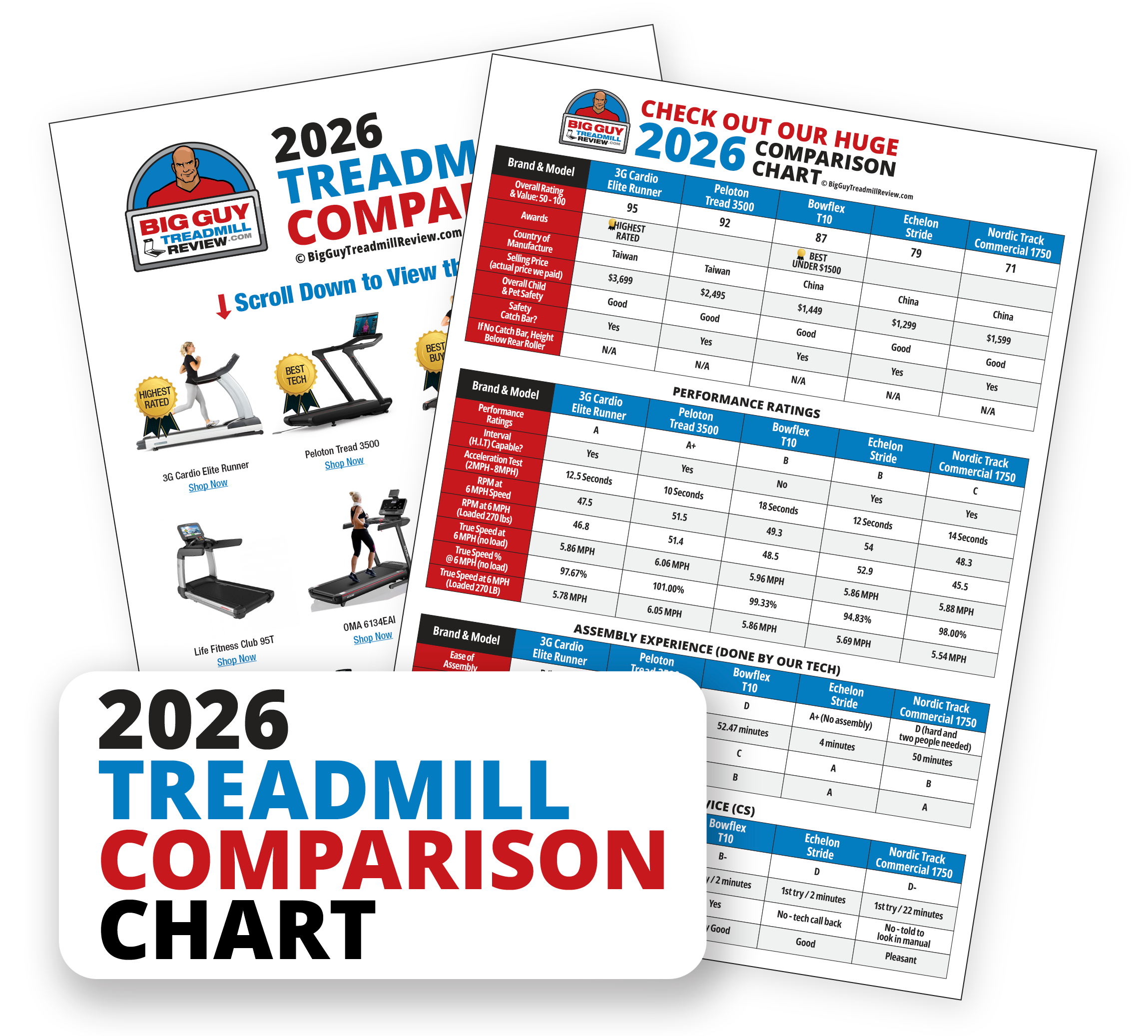
















Who Took Home the Gold?
Find out which 2026 Treadmills Reviewed got one of the Prestigious “Big Guy” Awards