Interval training has become one of the most popular and effective exercise methods for a reason. Alternating between bursts of intense activity and lower-intensity recovery boosts cardiovascular fitness, drives up your metabolic rate, and builds the kind of endurance that steady-state cardio just can’t match in the same amount of time. But there’s one factor that almost no one considers when shopping for a treadmill, and it quietly determines whether your interval workouts actually deliver those benefits or just leave you frustrated. That factor is acceleration speed: how long the belt actually takes to climb from a recovery pace to a sprint pace.
At 298 lb., Big Mike has stepped on plenty of treadmills that took longer to accelerate than the entire sprint interval was supposed to last. That’s why we measure acceleration on every machine that comes through the BigGuyTreadmillReview.com testing facility, and why we built our HIIT-capable badge specifically around this number. If a treadmill takes more than 16 to 20 seconds to climb from 2 MPH to 8 MPH, the rhythm of going back and forth between speeds gets thrown off badly enough to break the workout structure entirely.
How We Tested 20 Treadmills for Acceleration
Our team rated 20 of the leading treadmills on the market across dozens of criteria, but the acceleration test from 2 MPH to 8 MPH is the one that matters most for interval training. We start the belt at 2 MPH, hit the speed button to 8 MPH, and time how long the belt actually takes to settle at the new target speed. We do it unloaded and we do it with weight on the deck, because what happens at 270 lb. on the belt is rarely what happens with no rider at all. The numbers tell a clear story about which machines are built for HIIT and which are not.
HIIT-Capable Treadmills: Earned the Badge
The following treadmills earned our HIIT-capable badge by ramping from 2 MPH to 8 MPH fast enough that your sprint intervals will actually function as designed. These machines let you transition cleanly from recovery pace to sprint pace within a typical 30 to 60 second interval window, which is the bare minimum requirement for the workout to qualify as high-intensity training instead of just a treadmill walk with annoying speed changes.
- Peloton Tread 3500: 10 seconds (2 to 8 MPH)
- 3G Cardio Pro Runner X Treadmill: 11 seconds
- Echelon Stride: 12 seconds
- 3G Cardio Elite Runner X Treadmill: 12.5 seconds
- Life Fitness Club Series Plus: 13.5 seconds
- NordicTrack Commercial 1750 (2023): 14 seconds
- NordicTrack Commercial 1750 (2024): 17.5 seconds
Failing to Make the Grade (Err, Speed)
The following treadmills couldn’t keep up with HIIT timing requirements. Some are close enough that you can adapt your workout structure around longer intervals. Others are so far off the mark that interval training just isn’t possible on the machine without redesigning the entire training program around the equipment’s limitations.
- Horizon Fitness T103: 14.5 seconds
- ProForm Pro 2000 Smart Treadmill: 14.5 seconds
- Life Fitness Club 95T Achieve: 15 seconds
- Life Fitness T5 Treadmill with Go Console: 16.8 seconds
- Bowflex T10: 18 seconds
- Sole F80: 22.01 seconds
- Life Fitness T3 Track Connect: 27 seconds
- OMA 6134EAI: 31.23 seconds
- 3G Cardio 80i Fold Flat Treadmill: 38 seconds
- WalkingPad A1 Pro: Max speed of 3.7 MPH (can’t reach the 8 MPH target at all)
The OMA 6134EAI taking 31.23 seconds is rough. The 3G Cardio 80i Fold Flat at 38 seconds is honestly part of why that model was discontinued. And the WalkingPad A1 Pro never reaches 8 MPH at all because its top speed is 3.7 MPH, which makes it perfectly fine for an under-desk walking treadmill but completely disqualifies it from any conversation about HIIT training. Here’s the deeper reason why these slow numbers matter so much for your workout quality.
Seamless Transition Between Intervals
The primary reason acceleration speed matters is that it allows for seamless transitions between high-intensity and low-intensity intervals. When a treadmill ramps quickly, you can shift from a walk or jog into a sprint within a few seconds, and that rapid transition is what keeps the intensity pattern intact. The whole point of interval training is the contrast between the two speeds, and the contrast disappears if the belt spends most of the sprint window simply trying to reach sprint speed.
A treadmill with slow acceleration disrupts your rhythm in ways that compound across the workout. You start the sprint, you wait for the belt to catch up, you finally hit target speed for maybe 10 seconds, and then the rest period starts before you’ve truly maxed your effort. By the third or fourth interval, your pacing is completely off, your heart rate hasn’t been challenged the way the program intended, and the workout no longer resembles the protocol you planned to run.
Maintaining Heart Rate and Intensity
Interval training is designed to keep your heart rate fluctuating between high and low zones, which is exactly what makes it so effective for cardiovascular adaptation. Quick acceleration helps maintain the desired intensity during the high-intensity intervals and ensures your heart rate spikes quickly enough to actually reach the target zone. That heart rate spike is crucial for burning calories during the workout and for triggering the adaptations that build cardiovascular fitness over weeks of consistent training.
If the treadmill takes too long to reach your target speed, you might never achieve the necessary heart rate elevation in any given interval. The workout flattens into something closer to steady-state cardio with annoying speed changes, and the specific physiological response you’re training disappears. Worse, the data on your fitness tracker still says you completed the workout, which makes it easy to miss why your conditioning isn’t improving the way it should.
Maximizing Caloric Burn
One of the biggest advantages of interval training is its ability to maximize caloric burn both during and after the workout. The rapid acceleration of a quality treadmill lets you reach high-intensity speeds quickly, which drives up energy expenditure and pushes you into the calorie-torching zone faster. The faster you can get to your sprint pace, the more total time you spend at that high-output level across the whole session.
This efficiency also enhances the after-burn effect, technically known as Excess Post-Exercise Oxygen Consumption. The harder you push during sprint intervals, the more elevated your metabolic rate stays for hours after you finish. Slow acceleration suppresses the intensity peaks that drive that response, which means a treadmill with poor ramp performance is quietly cutting into your post-workout calorie burn even when the on-treadmill numbers look similar.
Enhancing Muscular Adaptation
Interval training places unique demands on your muscles, requiring them to adapt to varying intensities and changing loads within the same session. Quick acceleration on a treadmill ensures that your muscles are constantly challenged, improving their ability to generate power, sustain effort, and recover between bouts. This leads to enhanced muscular endurance and the kind of leg strength that translates into better performance on the road, in races, and in everyday life.
Slow acceleration produces a much weaker training stimulus. Your muscles aren’t being asked to respond to rapid load changes, which means they’re not adapting the way they would with proper interval training. You can run for the same total time on a slow-ramping treadmill and end up with measurably less muscular adaptation than someone running the same protocol on a HIIT-capable machine. The equipment quietly limits what your training can accomplish.
The Psychological Side of Quick Acceleration
The mental side of interval training is often overlooked but matters more than most reviewers admit. Rapid acceleration keeps you mentally engaged because the workout actually changes when the program says it should change. The quick transitions add an element of variety and intensity that prevents the boredom that quietly kills consistency in home training programs. Knowing that the belt will respond when you call for sprint pace builds confidence and makes the training experience more enjoyable session after session.
The opposite is also true. A treadmill that takes 25 seconds to reach sprint speed feels frustrating from the very first interval, and frustration kills consistency faster than almost anything else. People don’t quit home gyms because they hate exercise. They quit because the equipment feels like it’s working against them. Acceleration is one of those small specs that determines whether the treadmill becomes a tool or an obstacle.
Tips for Optimizing Acceleration in Your Workouts
Choose the right treadmill from the start. Not all treadmills are created equal, and acceleration time isn’t usually printed on the spec sheet. Look at independent testing data, ask the manufacturer directly for the 2 MPH to 8 MPH ramp time, and prioritize models known for quick acceleration capabilities. If the manufacturer can’t or won’t provide the number, that silence is the answer.
Warm up properly before high-intensity work. A good warm-up session prepares your body for the demands of rapid acceleration and dramatically reduces the risk of injury during the first sprint of the session. Five to ten minutes of progressively faster walking and easy jogging gives the cardiovascular system time to come online before you ask it to spike.
Plan your intervals strategically. Know your target speeds for both the high-intensity and low-intensity phases before you step on the belt. Match your interval length to your treadmill’s capabilities. If your machine ramps in 12 seconds, 30-second sprints work. If it ramps in 18 seconds, you’re better off with 60-second sprints so the belt has time to actually deliver the speed you programmed.
Stay focused during transitions. Pay attention to the speed display and be ready to adjust promptly to maintain the intended intensity. Some treadmills require you to hold the speed button rather than tap-and-go, and knowing your machine’s quirks turns smooth transitions into a habit instead of a fight.
The Bottom Line: Acceleration Decides the Workout
Acceleration speed on a treadmill is a critical factor that significantly influences the effectiveness of your interval training. Seamless transitions, maintained heart rate and intensity, maximized caloric burn, enhanced muscular adaptation, and the mental engagement that keeps you coming back all depend on the belt responding when you call for it. Investing in a treadmill with excellent acceleration capabilities and incorporating that performance into your training routine helps you achieve fitness goals more efficiently and far more enjoyably than fighting a slow-ramping machine.
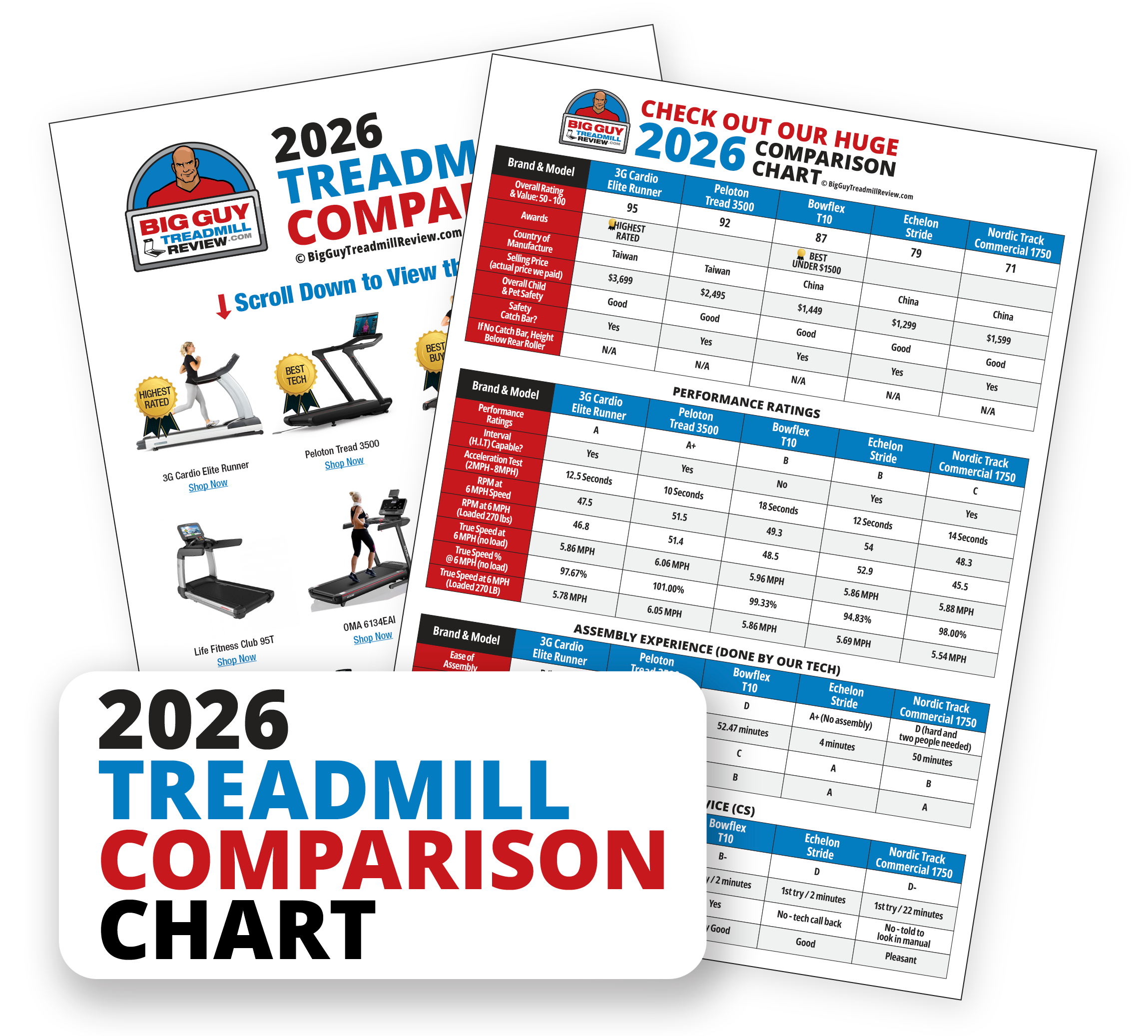
Most people don’t consider acceleration when shopping for a treadmill. We do, and at 298 lb., Big Mike has felt the difference between a 10-second ramp and a 30-second ramp in every interval workout he’s run on our test deck. The data doesn’t lie, the scale doesn’t lie, and neither do we. For a complete look at the BigGuyTreadmillReview rankings, visit our treadmill comparison chart and the individual treadmill reviews at BigGuyTreadmillReview.com where every number we publish came from our testing facility.

Want More Reviews or a Specific Product Reviewed?
Check out more unbiased reviews, comparison charts, and expert insights from Big Mike and his team.
Email us: [email protected]
Interested in a forum here? Let us know via email!