
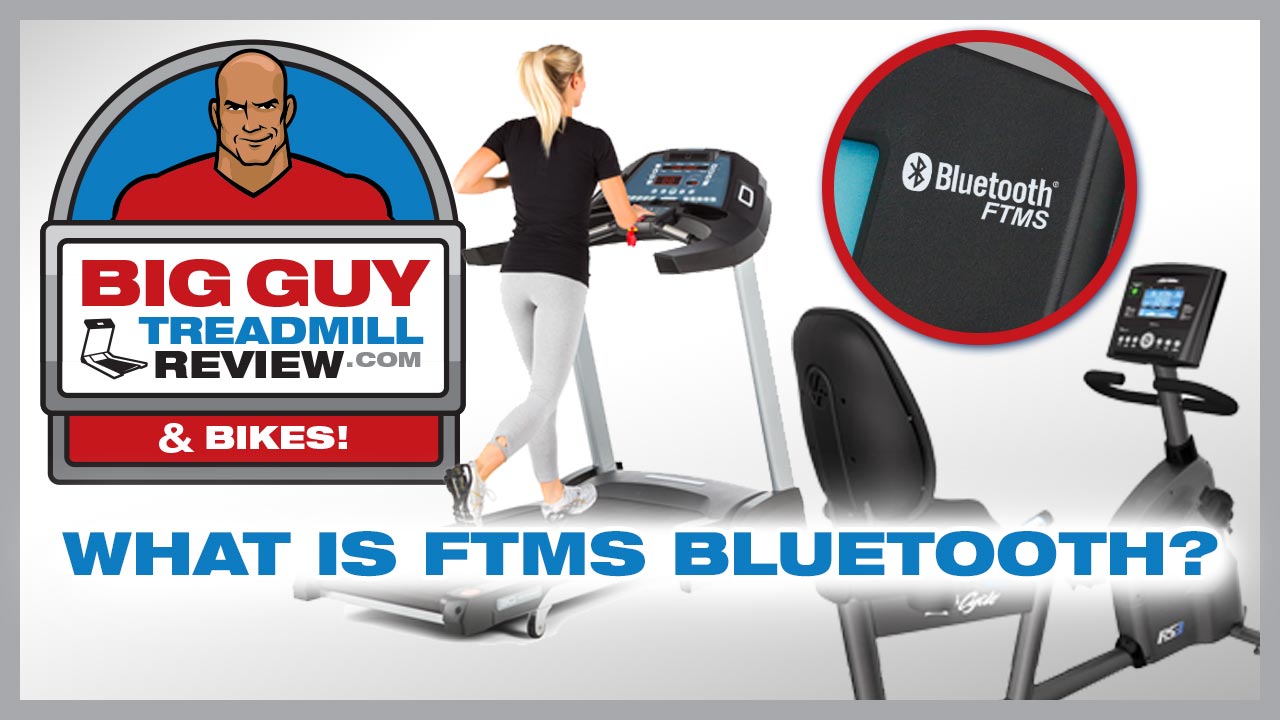
FTMS Bluetooth, short for the Fitness Machine Service protocol, is one of the biggest and most exciting breakthroughs in the specialty fitness industry in recent years. At 298 lb., Big Mike has tested enough connected fitness equipment to recognize a genuine technology advance from a marketing buzzword, and FTMS Bluetooth is the real thing. Our research and review team at BigGuyTreadmillReview.com has thoroughly enjoyed working with this technology across the compatible treadmills and exercise bikes we’ve put through our testing protocol, and the results consistently support a simple conclusion: FTMS Bluetooth changes the economics of buying fitness equipment in favor of the customer.
If you aren’t already familiar with FTMS Bluetooth, take a few minutes to read through this guide. Even if you’ve used it or heard about it from a sales rep, there’s a good chance you’ll learn something new about what the protocol actually does, what it explicitly cannot do, and why it represents a fundamentally better deal than the built-in tablet model that dominates the consumer treadmill market right now.
What FTMS Bluetooth Actually Is
FTMS Bluetooth turns your tablet or mobile device into a fully interactive fitness device for free when paired with treadmills or exercise bikes that are compatible with the protocol. The phrase “for free” is the key part. There’s no subscription, no membership tier, no proprietary content gate. The protocol is an open standard that any app developer can build against, which means you have a growing ecosystem of free or low-cost apps competing for your attention rather than a single locked-in subscription competing for your wallet.
There are many treadmills and exercise bikes on the market that are FTMS-compatible, and the list keeps expanding as the protocol becomes the de facto standard for serious specialty fitness equipment. We recommend doing your homework and confirming compatibility with specific models before you buy, because some manufacturers advertise “Bluetooth” without specifically supporting the FTMS protocol. The presence of generic Bluetooth on a treadmill doesn’t guarantee FTMS, and the difference matters when you actually try to connect to a third-party app.
If you purchase a treadmill or exercise bike that’s FTMS-compatible, you can sync up a free or paid app like Kinomap, Zwift, or Strava and immediately get interactive features that built-in consoles often charge a recurring subscription fee to deliver. Search the Google Play Store or the Apple App Store for additional fitness equipment apps and you’ll find an active development scene producing new options every quarter. Peloton even rolled out a free version of their app that can pair with treadmills beyond just their own models, which happened in the wake of a roughly 95% drop in their stock price and a strategic pivot to broaden the platform.
Why a Free App Beats a Built-In Tablet
Here’s the part the big-brand marketing departments don’t want you to think about. Many serious specialty fitness machines use old-school, LED-style built-in programs paired with FTMS Bluetooth connectivity for the smart features. There’s not a lot to go wrong with simple built-in electronics, which is exactly the point. The console runs the basic functions reliably for ten years, and the smart fitness experience runs on the device you already own and replace every few years anyway.
When you sync a treadmill to an app over FTMS Bluetooth, you avoid monthly subscription fees, you can change apps as often as you like, and you can swap out the smart device entirely without buying a new treadmill. Get a new tablet next year? Plug it in and keep training. Switch from Kinomap to Zwift to a new app that hasn’t even been built yet? Just download it and connect.
The problem with a fancy treadmill or bike that has a tablet factory-embedded into the console is that your equipment becomes only as good as those built-in electronics and only lasts as long as those electronics keep functioning. The embedded screen and processor are usually nowhere near the quality of a current Android, iPhone, or iPad. So what are you actually getting? Three or four years if you’re lucky, and then the smart features stop working, the manufacturer drops support, the firmware never updates, and you no longer have a fully working treadmill. The hardware that should outlast the electronics dies because the electronics died first. That’s the trap FTMS Bluetooth lets you avoid.
What FTMS Bluetooth Doesn’t Do
FTMS Bluetooth will not change the speed of your treadmill while paired with the machine through an app. This is the one significant limitation of the protocol, and it exists for a deliberate safety reason. No reputable manufacturer will let an app automatically speed up or slow down a treadmill belt because the liability of an automated belt accelerating unexpectedly under a 250 lb. runner is enormous. Companies cannot legally or ethically allow that, so FTMS treats speed control as a manual user input even when the rest of the experience is fully connected.
Users still have to manually change speeds on the console even while an app is paired with their machine through FTMS Bluetooth. The app does log the treadmill speed in real time as the user changes it, so your workout data is still completely accurate and uploads to the connected app. You just don’t get hands-free speed control, and frankly, you don’t want hands-free speed control on a piece of equipment that can throw you off the back of the deck if it accelerates without warning. That single limitation aside, the rest of the FTMS Bluetooth feature set is genuinely impressive.
What FTMS Bluetooth Does
The functions FTMS Bluetooth enables through a connected app include tracking and analytics, custom workout creation, progress tracking, social connectivity, and entertainment options ranging from virtual routes to music streaming and even podcast support during workouts. When the equipment is synced with a compatible app, the app sends and receives data in real time covering time, speed, calories burned, distance traveled, and on supported equipment can even change the treadmill’s incline elevation automatically based on the route or workout profile loaded into the app.
A treadmill with FTMS Bluetooth paired to an interactive app does exactly what it’s told to do (within the speed-control limitation noted above) and provides accurate, real-time feedback to the workout system. The result is a connected fitness experience that matches or beats what built-in tablets deliver, except you’re not locked into a single proprietary subscription and you’re not relying on console electronics that will eventually fail and brick your equipment.
It’s worth knowing that not all fitness apps behave the same way through FTMS Bluetooth. Some have polished user interfaces and broad route libraries. Others focus on competitive social riding or running. A few are still rough around the edges. Do your research, try a few, and see which one matches your training style. The beauty of FTMS Bluetooth is that you can swap apps freely instead of being locked into whatever software the manufacturer happened to embed in the console at the factory three years ago.
One emerging development worth watching: Kinomap is reportedly working on a VR-style app similar to what runs on devices like the Oculus, with an interactive experience comparable to Google Street View applied to fitness training. There’s a lot of new technology in the FTMS pipeline because the protocol is open and developers can build freely against it. Whatever the latest and greatest app turns out to be over the next few years, equipment with FTMS Bluetooth capability can connect to it. You’re not stuck with one built-in tablet running one company’s proprietary software that may or may not exist in 2030.
How Apps Interact Differently Through FTMS
Even though FTMS Bluetooth is a standard protocol, individual apps interpret and use the data slightly differently, especially when it comes to interactive features like incline changes. With Kinomap, for example, you might be running a virtual trail through the mountains and see on the app that you’re at 1% elevation, but the treadmill hasn’t actually inclined yet. The app may not have triggered enough of an incline command to raise the deck. When the app reads 2%, the treadmill might finally lift to 1%. From there, you might lock into a 1:1 ratio with the app and the treadmill matched at every increment. Or the values might continue to run one step apart.
Neither pattern is wrong. Each app handles the FTMS data stream differently based on developer choices, and that’s a feature of the open protocol, not a bug. We think it’s important for treadmill buyers to understand that each app will interact slightly differently through FTMS Bluetooth, and that the right approach is to try a few apps with your equipment to find the combination that feels best for your training style. The flexibility itself is the value.
The Built-In Tablet Money Grab
Most everyone who’s owned a tablet or smartphone in the 2020s knows how this story ends. Even the best Android and Apple products only last four or five years before performance degrades, the operating system stops getting updates, or the battery loses meaningful capacity. Now think about buying a treadmill for $2,500 or more with fancy embedded electronics, knowing that built-in tablet is almost certainly lower spec than the current iPhone, runs an older Android variant, and will get fewer updates than your phone gets. How long will that console actually last as a smart fitness device? Three years if you’re lucky. Maybe four.
Do you really want to spend $2,500 to $5,000 on a treadmill and have the smart functionality stop working in three or four years because the electronics malfunctioned, the firmware locked, or the manufacturer simply moved on? At BigGuyTreadmillReview.com, we’ll call it what it is: a money grab. The whole industry has been working in specialty fitness for many years, and the consensus on our team is that FTMS Bluetooth is the better deal for the customer in almost every scenario. The companies pushing hard-wired embedded electronics are doing it because they want your recurring subscription membership. They want you locked into a $40 per month fee for content that should already be free, and they want the equipment depreciation curve tied to their content business rather than the actual mechanical durability of the machine.
Everyone should be able to choose. That’s the underlying argument for FTMS Bluetooth. It’s not right for everyone, and some buyers want the built-in fancy extras and aren’t concerned about the higher upfront price or the eventual obsolescence. That’s a valid choice. But if you want a treadmill where the smart features stay current as long as your phone or tablet stays current, FTMS Bluetooth is the way to go. 3G Cardio ships its lineup with FreeSync™ FTMS Bluetooth, which is exactly the kind of open-standard approach we’re talking about. Sole Fitness and Horizon Fitness also build FTMS Bluetooth into multiple current treadmill models, which gives buyers solid options across different price points and use cases. No subscription required, no embedded tablet to fail, just clean connectivity to whatever app you want to use.
The Bottom Line
FTMS Bluetooth is, at its core, the open-standard alternative to the subscription treadmill model. It does almost everything the embedded-tablet brands charge a monthly fee to deliver, and it does it through devices you already own and replace on a normal upgrade cycle. The single limitation, manual speed control, exists for genuine safety reasons and isn’t going away. Everything else in the connected fitness experience is on the table: real-time tracking, custom workouts, virtual routes, social features, automatic incline changes, and a steady stream of new apps from a growing developer ecosystem.
The smarter path for most buyers is to choose a high-quality treadmill or exercise bike with simple, bulletproof LED-style built-in electronics and FreeSync™ FTMS Bluetooth or equivalent FTMS support. Don’t pay extra for fancy embedded electronics that drive up the purchase price and become obsolete in three to four years. Get the simple console, get the open protocol, and connect your own free or low-cost apps. For our full take on which treadmills and recumbent bikes deliver this combination at the right price points, see the treadmill comparison chart and individual reviews at BigGuyTreadmillReview.com. The data doesn’t lie, the scale doesn’t lie, and neither do we.

Want More Reviews or a Specific Product Reviewed?
Check out more unbiased reviews, comparison charts, and expert insights from Big Mike and his team.
Email us: [email protected]
Interested in a forum here? Let us know via email!
Featured FTMS-Compatible Reviews from BGTR
These are the FTMS-equipped treadmills and recumbent bikes we’ve tested first-hand. Each review covers the specific FTMS implementation, app compatibility, and subscription independence:
- 3G Cardio Elite RB X Review — FreeSync FTMS, narrow Q-factor, 350 lb capacity
- 3G Cardio Elite Runner Treadmill Review — FreeSync FTMS, heavy-duty build
- 3G Cardio Pro Runner X Treadmill Review — FreeSync FTMS, sub-$2,500
- Horizon Fitness 7.8 AT Treadmill Review — FTMS Bluetooth, sub-$2,000
- Sole R92 Recumbent Bike Review — FTMS Bluetooth, under $1,000
- Spirit Fitness XT685 Treadmill Review — FTMS Bluetooth, residential + light commercial
- NordicTrack 1750 Treadmill Review — FTMS Bluetooth Module embedded